Prologue / The profession on trial · Unabridged
The Six I’s of Institutional Failure
The idiocy, the incompetence, the incompatibility of institutional indignation of the indoctrinated with justice.
It would be spectacular comedy if the price of admission weren't paid in childhoods, family relationships, financial ruin, and futures that cannot be restored.
The American People did not establish courts to preserve the comfort, wealth, or professional dignity of lawyers. They established them to administer JUSTICE.
And if a supposedly learned profession finds that distinction offensive, perhaps it should consider the possibility that its education is part of the problem.
Public Money. Private Contractors. One Deprecated Profession of Antiquity.
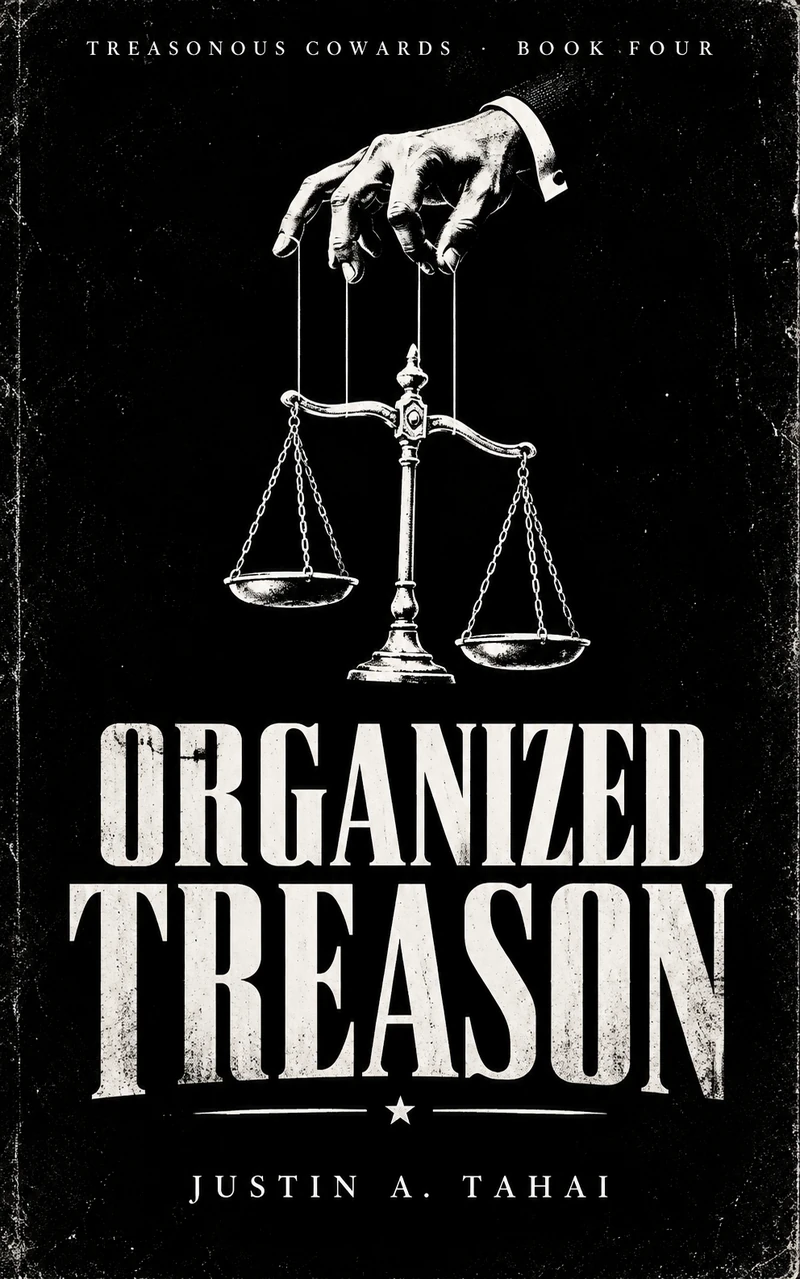
ORGANIZED TREASON — The racket isn't merely what they charge. It's what the People continue paying for, and what children continue losing, while the machinery congratulates itself for functioning exactly as MISDESIGNED.
There. The charge is on the table. A profession that demands reverence for its expertise ought to survive the most elementary performance review in civilization: Did you actually help the people? Instead, too much of the machinery treats its procedures as sacred, its inconveniences as emergencies, its mistakes as mysteries, and everybody else's ruined calendar as an unfortunate cost of doing business. The public did not commission a graduate seminar in why a broken system must be respected. It hired a profession to administer justice. If that distinction is still confusing, perhaps the next continuing-education course should be called What the Hell Was the Job?
It is also an invitation to the public to stop applauding a machine merely because it makes an impressive noise. A machine can stamp, invoice, schedule, defer, reschedule, certify, and produce a three-page explanation of why it needs another ninety days. None of that proves it delivered justice. A toaster that only prints a beautiful receipt for bread would be recalled before breakfast. Government can apparently commission a feasibility study on whether breakfast is a reasonable expectation.
I. Idiocy — The process has eaten the purpose
Idiocy is not a diagnosis of anybody's intelligence. It is the name for a design that cannot answer the elementary question: Did the service accomplish what it was supposed to accomplish?
In the modern world, we can reroute an ambulance, authenticate a banking transaction, and locate a parcel in near real time. Yet public institutions can still speak of a child's disappearing years as though they were a tolerable by-product of the proper movement of paper. Somewhere a deadline gets an extension. Somewhere a form gets another form. Somewhere an official pronounces the matter “procedurally regular,” which is an extraordinarily fancy way of saying that the gears turned even if the person caught in them did not come out better.
The most extravagant stupidity is the suggestion that more procedure is always more justice. Sometimes it is. Due process protects people against arbitrary power, and a careful hearing can prevent terrible mistakes. But there is an enormous difference between the process that protects a person and the process that protects itself from having to deliver anything. One deserves constitutional respect. The other deserves a process improvement ticket and, if necessary, a very large shredder.
Imagine a hospital that congratulates its billing department for treating every invoice while leaving every patient in the waiting room. Its administrators would be asked about medical outcomes. The legal profession has no persuasive answer when the equivalent question—What happened to the family?—is treated as an objectionable interruption of the docket.
The price of this idiocy is not abstract. Children grow. Educational opportunities come and go. Families incur expense and uncertainty. The system cannot issue an order restoring age twelve to a person who is now sixteen. The Clerk may stamp a document received. Time has never agreed to the extension.
II. Incompetence — The credential is not the deliverable
A license establishes that someone completed a required professional path. It is not a perpetual performance warranty. A law degree is not a magical amulet that wards off bad decisions, broken workflows, poor listening, or the embarrassing discovery that the customer has a point.
In any competent organization, repeated failure invites questions about root causes. Where is the handoff failing? Which queue is overloaded? Why are routine tasks being reworked? What percentage of submissions are returned for technical reasons? How long does a child's interim relief actually take? Who has authority to fix the recurring defect, and why has that person not done so?
These are not radical questions. They are the humiliatingly ordinary questions asked by people who operate airports, warehouses, payroll systems, emergency departments, and the rest of civilization. And yet the legal machinery can regard elementary performance measurement as an existential threat, as though a dashboard showing missed deadlines might summon the collapse of the republic.
Don't confuse professional difficulty with a pardon for poor performance. Constitutional process is difficult. Confidentiality is difficult. The safety of a child can require grave and complex judgments. Those are arguments for competence, training, review, and careful correction—not arguments for unlimited delays accompanied by an invoice and a lecture about respecting the profession.
Competence includes admitting error. It includes not hiding a broken workflow behind the people forced to navigate it. If the public must pay for expertise, the public may reasonably expect evidence that expertise improves the result. Otherwise the credential is simply a very expensive label on an untested product.
III. Institutional — The org chart without an owner
Institutional failure has a distinctive sound. It is the sound of seven offices explaining, with perfect courtesy, why the eighth office is responsible.
One office owns the form. Another owns the software. Another owns the rule. Someone else owns the contract. A committee owns the roadmap. A vendor owns a deliverable whose acceptance was approved by a department whose name appears in a report written by a consultant. And who owns the consequence when the service does not work? Behold: the only item in the building without an assigned custodian.
This is the peculiar genius of a misdesigned institution: responsibility evaporates as it moves upward, while cost trickles downward with remarkable reliability. The taxpayers receive the invoice. Families receive the delay. The organizational diagram receives a new box. The problem receives an acronym.
Public money deserves an auditable chain from promise to payment to actual public benefit. A contract should have a measurable service standard. An accepted milestone should have evidence. A recurring failure should have an identified decision-maker and deadline. An independent review should be capable of saying something more useful than “further review is recommended.”
That is not hostility toward public servants. It is protection for the diligent public servant who is tired of inheriting the same preventable mess. Good employees should not be sacrificed to defend a poor system. Nor should good judges and lawyers have their work confused with a professional culture that treats accountability as a breach of etiquette.
When authority is collective but accountability is nowhere, the structure is not majestic. It is a group project in which everyone signed the cover page and nobody did the assignment.
IV. Indignation — The profession's most reliable emergency service
Here is a fascinating institutional reflex: the public identifies a failure, and the institution identifies a tone problem.
The service might be inaccessible. The time might be lost. The family might be drowning in expense. But heaven forbid a citizen employ a sharp adjective. Suddenly urgency appears. The people who could not locate a workable remedy have discovered a remarkable capacity for immediate, coordinated action: they are offended.
Apparently, institutional indignation is the one motion that never gets denied.
To be clear, abuse, threats, and harassment are not entitled to a free pass. Nor should professional employees be expected to absorb endless personal attacks. But criticism of public performance is not automatically abuse because it embarrasses the people responsible. A system that can litigate the tone of a complaint for months while declining to answer its substance has confused professional dignity with public service.
What was the promise? What did the record show? What changed after notice? Which feasible correction was rejected, and why? Those questions do not become less important because somebody is furious that they were asked. Being called out is not a procedural injury. It is sometimes a predictable consequence of failing to do the job.
Imagine a mechanic who leaves the brakes disconnected and then files a grievance because the customer said “what the hell.” The customer might owe the mechanic a calmer sentence. The mechanic still owes the customer working brakes.
The profession has mastered the objection. The public would like to see comparable enthusiasm for the solution. And anyone who considers this criticism beneath the dignity of the profession is welcome to explain, in equally refined language, exactly who is supposed to return the years already lost.
V. Indoctrinated — The tradition that forgot its reason
The most dangerous lesson in any powerful profession is not a rule. It is the idea that questioning the rule proves you do not understand the profession.
A newcomer learns the vocabulary, the hierarchy, and the ceremonial choreography. Eventually the machinery becomes familiar. Familiarity becomes legitimacy. Legitimacy becomes immunity from ordinary questions. By graduation, the practitioner may be able to explain thirteen exceptions to a filing deadline but struggle to say why a person should require a second job, a second mortgage, or a second decade of life to get a straightforward answer.
That is indoctrination as institutional satire, not a claim about every lawyer's mind. There are conscientious attorneys, capable judges, honest clerks, vigilant advocates, and reform-minded administrators. The ones worth defending are precisely those who will look at a bad process and say, “This is a bad process.” A profession has not demonstrated its learning merely because it can reproduce the language of the last generation.
Education is supposed to cultivate judgment. It should teach people how to distinguish a necessary safeguard from an expensive ritual, and a real public duty from a professional custom wearing a powdered wig. When criticism is answered with “you wouldn't understand,” the public is entitled to ask whether there is anything there to understand besides the maintenance of privilege.
Professional prestige is not an excuse to stop learning from other disciplines. Engineers test systems. Clinicians study outcomes. Investigators compare statements to evidence. Accountants reconcile money. The legal profession could borrow a little of each without suffering a constitutional crisis. Especially the part where a failed test is treated as information instead of an insult.
And if the lesson is that the institution must be defended even when the public can demonstrate a defect, the lesson is wrong. No amount of Latin rescues it.
VI. Incompatibility — The ceremony and justice cannot occupy the same throne
Justice requires authority, fairness, reliable evidence, safety, and the opportunity to be heard. It also requires consequences that arrive while they are still useful. An order issued years after its practical purpose has vanished may close a file. It cannot reopen a childhood.
The incompatibility is not between law and reform. It is between justice and a professional culture that mistakes the maintenance of its own procedures for the delivery of the public good. It is between a child's clock and an institution that insists the calendar is somebody else's problem. It is between the promise of equal access and the business model that makes ordinary citizens financially dependent on intermediaries to exercise rights already said to be theirs.
This is where the racket comes into view: an economic pattern the public has every right to expose, test, and refuse to subsidize. Complexity creates dependence. Dependence creates expense. Delay creates more work. More work can create more billing. Outsourcing creates contracts, oversight contracts, change orders, and occasionally the breathtaking discovery that overseeing the previous oversight requires fresh oversight. Even where every individual transaction is lawful, the system can still reward continuation more readily than correction.
And where records show actual deception, self-dealing, or misuse of public funds, the proper response is not a polite footnote about optics. It is independent investigation, lawful enforcement, recovery where warranted, and correction. In the meantime, the structural critique does not need a fabricated criminal conviction to stand up. It needs the invoices, the benchmarks, the waiting times, the decisions, and the public courage to compare promises with results.
The cold war against ordinary Americans is a metaphor for attrition: no tanks rolling down Main Street, just the slow accumulation of fees, missed opportunities, administrative barriers, procedural exhaustion, and years that cannot be purchased back. The casualties are often invisible to the people making the presentations because the metric on the slide is “cases disposed,” not “lives put back together.” An entire family can be reduced to a docket entry, and the docket entry can be pronounced a success.
That is a remarkably efficient way to win the paperwork and lose the point.
Six defects, one business model
Now watch the Six I’s do something more useful than sit on a motivational poster for disappointed taxpayers. Idiocy makes the process unnecessarily complicated. Incompetence lets the complication survive its own failures. Institutional fragmentation distributes responsibility until no one owns the answer. Indignation punishes the person who notices. Indoctrination teaches the next generation to call the arrangement professional judgment. And incompatibility is the result: a machinery of justice increasingly efficient at defending the machinery of justice.
The financial incentives do not need a cartoon villain stroking a cat. They need only a design in which conflict produces billable work, billable work produces dependence, dependence makes exit expensive, and every unsuccessful attempt to get relief becomes an opportunity for another professional intervention. A profitable bottleneck is still a bottleneck. A child’s lost year is still lost even when every participant has an impressively laminated explanation.
And here comes the most exquisite trick: the advocate operates as a private professional for purposes of fees, but asks an arm of the State to give the argument enforceable consequences. That does not make every lawyer a state actor under federal law. It does raise an urgent public-accountability question about what safeguards prevent a confident assertion from acquiring the force of government before its truth has been adequately tested. The officer of the court should not be the last person expected to remember the court’s obligation to truth.
Call that arrangement a racket in the language of political economy and institutional satire. If the transactions reveal the specific crimes required by the federal RICO statute, investigate and prosecute them on the proof. Do not mistake one meaning for the other. The public does not have to wait for a felony conviction to reject a system that rewards delay while children age out of the remedy.
That is the road this book takes: misdesign, money, deference, attrition, the RICO question, and the final accusation—ORGANIZED TREASON. Nothing is more tedious than a professional organization congratulating itself for an accomplishment the public cannot locate. Nothing is more obscene than a profession calling the missing childhood an unfortunate scheduling consequence.
The public's counteroffer: results, not reverence
Enough of the ceremonial declarations that the system cares deeply. Ask for the operational proof. Publish the median time between request and meaningful action, including whether emergency or child-impact matters actually receive timely attention. Report how often technical returns force duplicate work. Measure whether ordered services are implemented. Publish vendor milestones, acceptance evidence, payments, credits, and remedies for nonperformance. Provide accessible pathways that do not require a paid interpreter of the user interface. Protect privacy while reporting aggregate outcomes. Put a named owner and a deadline on every corrective action.
Invite independent auditors and people who actually use the service into the room. Hear from judges and lawyers who know where the machinery breaks and from staff who have been making quiet workarounds for years. Open oversight hearings to the public. Demand plain-language answers from lawmakers and administrators. Support reforms that can be tested rather than promises that can only be admired.
Above all, stop treating children as an acceptable holding cost. Their developing lives are not a reserve account on which an institution may draw unlimited extensions. Some disputes require protective distance and careful fact-finding; those safeguards belong at the center of any responsible reform. So does the obligation to make the decision promptly, verify the facts, and give a lawful remedy a real-world path to implementation.
No party, political brand, professional association, or vendor gets exclusive rights to these demands. They are a public standard. Readers can share this chapter, ask their representatives for documented performance measures, attend oversight hearings, submit testimony, and insist on transparent corrective action. The mission is lawful, public, relentless accountability—not harassment and not revenge.
The American People do not need another performance of professional indignation. They need a service worthy of the name. And the legal profession should be capable of surviving a question so obvious that it ought to be printed above every courthouse entrance:
WHAT HAPPENED TO THE PEOPLE WE WERE SUPPOSED TO HELP?
Do not answer with the title of the form. Do not answer with the number of hearings. Do not answer with the impressive growth in the committee's acronym. Answer with an outcome. Answer with a correction. Answer while it can still matter.
Public Money. Private Contractors. One Deprecated Profession of Antiquity.
The racket is not merely what they charge. It is what the People continue paying for—and what children continue losing—while the machinery congratulates itself for functioning exactly as MISDESIGNED.
Read, share, scrutinize, and demand measurable reform: JTforME.com.
© 2026 Justin A. Tahai · Free to read and share with attribution. This is the full text of the prologue in the supplied eleven-page public-excerpt PDF; cover and page numerals are not repeated in the article text.